Published By ANI News
Published By ANI News
New Delhi [India], February 2: The Union Budget 2026 Urbanisation focus clearly shows that the government is serious about long-term development. The Union Budget 2026 is not just about increasing spending. It is about strengthening India's cities and supporting balanced growth across the country.
One of the biggest highlights of the budget is the rise in Public capital expenditure in 2026 to Rs. 12.2 lakh crore. This strong increase under Infrastructure Capex 2026 proves that the government wants to build better roads, railways, metro systems, airports, utilities, and logistics networks. These investments lay the foundation for a well-planned, sustainable urban expansion.
The focus on India's urbanisation growth is clear in the Budget 2026. Urbanisation is no longer limited to big metro cities like Delhi, Mumbai, and Bengaluru. The government is now encouraging growth in smaller and emerging cities as well.
With higher Urban infrastructure investment in India, cities will get better transport systems, clean water supply, smart utilities, and improved public services. This will make cities more livable and business-friendly.
The Budget 2026 infrastructure boost ensures that development continues without policy changes or sudden shifts. This policy continuity builds confidence among investors, developers, and businesses.
A major part of the Union Budget 2026 Urbanisation strategy is promoting Tier 2 and Tier 3 Cities Development. These cities are slowly becoming strong economic centers rather than mere extensions of metro cities.
Better highways, railway connectivity, and new economic corridors are helping smaller cities grow faster. As infrastructure improves, industries and service sectors are expanding into these locations. This leads to job creation and higher local income.
Improved connectivity also reduces pressure on metro cities. People and businesses now have more options for settling and growing in emerging urban areas.
Connectivity is one of the biggest drivers of urban growth. The Infrastructure Capex 2026 includes major improvements in transport and rail networks. The announcement of High-speed rail corridors in India is expected to transform inter-city travel.
Faster travel between cities will support business expansion, reduce commuting time, and open new residential and commercial markets. It will also help in planned city development along these new corridors.
Better connectivity means better opportunities. When transport systems improve, real estate demand naturally increases in surrounding areas.
The Infrastructure-led Real Estate Growth model is becoming stronger with Budget 2026. When infrastructure improves, developers feel more confident to invest in new housing and commercial projects.
The growth of business parks, office spaces, retail hubs, and logistics centers is expected to increase. There will also be noticeable real estate growth in Tier 2 cities, as improved infrastructure makes them more attractive to homebuyers and investors.
Stable policies and steady capital expenditure reduce financial risk. This encourages long-term investments in urban projects.
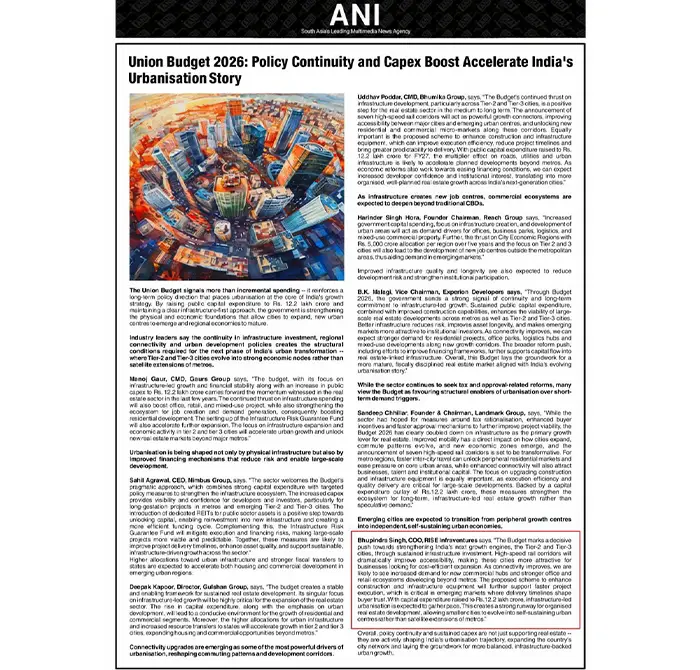
Bhupindra Singh, COO, RISE Infraventures, says:
The Union Budget 2026 sends a strong message about empowering India's emerging growth centres, especially Tier-2 and Tier-3 cities, through continued infrastructure investment. The announcement of high-speed rail corridors will significantly enhance connectivity, making these locations more appealing to companies seeking affordable, scalable expansion opportunities. As transportation networks improve, we expect rising demand for commercial hubs along with stronger office and retail markets outside major metros. The proposed initiative to upgrade construction and infrastructure equipment will also help speed up project execution, which is crucial in developing cities where timely delivery builds buyer confidence. With public capital expenditure increased to Rs. 12.2 lakh crore, infrastructure-driven urbanisation is likely to accelerate further. This provides a solid foundation for organised real estate development, enabling smaller cities to grow into independent and self-sustaining urban economies rather than remaining dependent on metro regions.
His statement highlights how infrastructure improvements can change the future of emerging cities.
Overall, the Union Budget 2026 Urbanisation plan focuses on long-term and balanced development. Instead of short-term incentives, the government has chosen to strengthen the base of economic growth through infrastructure.
The strong Public capital expenditure 2026, which focuses on connectivity and the promotion of Tier 2 and Tier 3 Cities Development, clearly shows a structured growth plan. The budget supports sustainable city expansion, improved mobility, and better commercial ecosystems.
The Union Budget 2026 is not just about numbers. It is about shaping the future of Indian cities. With steady investment and policy continuity, India is moving toward a more connected, balanced, and future-ready urban economy.
(Advertorial Disclaimer: This content has been supplied by NewsVoir as a press release. ANI does not accept responsibility for the accuracy or claims made in this material.)
Disclaimer: No Rise Infraventures Limited was involved in the creation of this content.
1. What is the main focus of the Union Budget 2026 on urbanisation?
The main focus of the Union Budget 2026 on urbanisation is to strengthen infrastructure and support long-term growth in India. The government has increased capital expenditure to boost city development and connectivity.
2. How much is the Infrastructure Capex 2026 allocation?
Under Infrastructure Capex 2026, the government has increased public capital expenditure to Rs. 12.2 lakh crore. This will support roads, railways, urban transport, and other infrastructure projects.
3. How will the Union Budget 2026 impact Tier 2 and Tier 3 cities?
The budget strongly supports Tier 2 and Tier 3 Cities Development by improving connectivity, transport systems, and urban infrastructure. This will create jobs and attract businesses to smaller cities.
4. What role do high-speed rail corridors play in India's urbanisation growth?
The new High-speed rail corridors in India will improve connectivity between cities. This will reduce travel time, encourage business expansion, and support real estate growth in emerging urban areas.
5. How will the Budget 2026 infrastructure boost affect real estate growth?
The Budget 2026 infrastructure boost will promote Infrastructure-led Real Estate Growth. Better roads, rail, and utilities will increase demand for housing, offices, and commercial spaces, especially in Tier 2 cities.

Fill the form below and we'll get back to you within 24 hours
🔒 Your information is secure and will not be shared