Published by CNC 24
Published by CNC 24
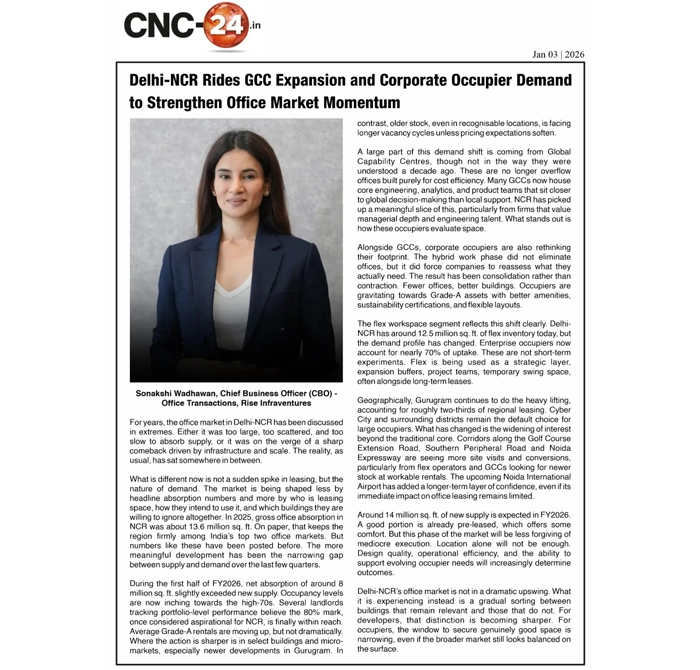
The Delhi NCR office market is showing steady and healthy growth as demand from Global Capability Centres and corporate occupiers continues to rise. Instead of sudden spikes or sharp recoveries, the region is experiencing balanced and sustainable momentum. This shift is driven not only by volume but also by the quality of demand and the types of occupiers choosing office space across the region.
For many years, the office market in Delhi NCR was often viewed in extremes. Some believed it was too large and slow to absorb new supply, while others expected a rapid comeback driven by strong infrastructure and scale. The reality today lies somewhere in between. The market is evolving steadily, supported by focused demand and better alignment between supply and occupancy.
In 2025, gross office leasing in the region touched nearly 13.6 million square feet. This keeps NCR among the top office markets in India. However, what matters more now are the office absorption trends in Delhi NCR, which show a clear narrowing gap between supply and demand. During the first half of FY2026, net absorption of around 8 million square feet slightly exceeded new supply. As a result, overall occupancy levels are moving closer to the high-seventy per cent range, with many experts expecting them to reach eighty per cent soon.
Rental growth in Grade A office space in NCR remains stable and controlled. While average rents are rising slowly, demand is stronger in select buildings and micro-markets, especially in newer developments in Gurugram. Older office buildings, even in well-known locations, are facing more extended vacancy periods unless pricing becomes more realistic. This shows that occupiers are becoming selective and quality-focused.
A major driver of this shift is GCC expansion in India. Global Capability Centres today are very different from what they were a decade ago. These centres are no longer set up only to save costs. Many now handle core engineering, analytics, research, and product development functions. Delhi NCR has emerged as a preferred location for such centres due to its strong talent pool, depth of management, and access to modern office infrastructure.
Along with GCCs, large companies are also reshaping corporate office leasing in Delhi NCR. Hybrid work has changed how offices are used, but it has not reduced their importance. Instead of closing offices, companies are consolidating their operations. They are choosing fewer locations but better buildings. Demand is clearly moving toward Grade A office space with modern amenities, sustainability features, flexible layouts, and strong property management.
The flex workspace segment clearly reflects this trend. Delhi NCR currently has about 12.5 million square feet of flex office inventory. What is notable is that nearly 70% of demand now comes from enterprise-level occupiers. These companies use flex spaces not as short-term solutions but as part of long-term strategies. Flex offices are being used for expansion plans, project teams, and temporary workspace alongside traditional long-term leases.
From a location perspective, Gurugram continues to lead leasing activity, accounting for nearly two-thirds of total demand in the region. Cyber City remains the most preferred business district. At the same time, interest is spreading to newer corridors such as Golf Course Extension Road, Southern Peripheral Road, and the Noida Expressway. These areas offer modern buildings at competitive rentals and are gaining attention from both GCCs and flex operators. The upcoming Noida International Airport has also added long-term confidence, even if its immediate impact on office leasing is limited.
Looking ahead, around 14 million square feet of new office supply is expected in FY2026. A large part of this space is already pre-leased, which brings stability to the market. However, this phase will reward only well-planned projects. Location alone will not be enough. Design quality, efficient operations, and the ability to meet changing occupier needs will decide success.
Overall, the Delhi NCR office market is not experiencing a dramatic boom. Instead, it is going through a clear sorting phase. Buildings that meet modern standards are seeing strong demand, while outdated assets are falling behind. For developers, this means a higher focus on quality. For occupiers, it means the best office spaces are becoming harder to secure, even though the market still appears balanced on the surface.
1. What is driving the growth of the Delhi NCR office market?
The Delhi NCR office market is growing due to GCC expansion in India, increased demand from corporate occupiers, and the rise of modern Grade A office space in NCR. Better infrastructure and strategic locations also support growth.
2. How are Global Capability Centres influencing office absorption trends in Delhi NCR?
GCCs now handle core engineering, analytics, and product functions, boosting corporate office leasing in Delhi NCR. Their presence has changed office absorption trends in Delhi NCR, driving demand for modern, high-quality office spaces.
3. Which areas in Delhi NCR are preferred for new office spaces?
Gurugram remains the top location, especially Cyber City, along with Golf Course Extension Road, Southern Peripheral Road, and Noida Expressway. These areas provide premium Grade A office space in NCR for GCCs and corporate occupiers.
4. What is the current office absorption trend in Delhi NCR?
Net absorption in Delhi NCR has steadily increased, with occupancy levels nearing 70–80% in FY2026. High-quality Grade A offices in select micro-markets are driving these office absorption trends in Delhi NCR.
5. How is corporate office leasing evolving in Delhi NCR?
Companies are consolidating their offices, choosing fewer but better buildings with modern amenities, flexible layouts, and sustainability features. This has increased demand for Grade A office space in NCR and strategic flex office solutions.

Fill the form below and we'll get back to you within 24 hours
🔒 Your information is secure and will not be shared